I was wandering through the grocery store and I realized that I’ve started to read labels out of habit. It could be because I am thirsty for knowledge and want to share my findings on this blog. It could also be the fact that I am constantly on the search for “safe” foods for my boyfriend and every time I look at a product, I wonder “Could I eat this with him?”
I had one such moment while looking at Amore brand paste. If you haven’t seen it, it’s ingenious. They have a variety of common Italian ingredients that people might not want to hassle with, such as anchovies or tomatoes. Instead, what they do is turn it into a paste so all you have to squeeze a little onto a measuring spoon and you’re good to go. I was especially intrigued by the tomato paste because my boyfriend is very committed to buying fresh food in season. This means that if we want tomatoes, we have to find someone selling locally-canned jars so that we can make sauce. Buying it in paste form would make it so much easier!
Looking on the back of the package, I saw something amazing. Not only were there no “unsafe” ingredients (YAY!), but they were extremely honest about allergen potential. They stated that the product was made in a plant which also processes fish and tree nuts. I know that this is fairly common among food labels, however they went on to define tree nuts as cashews and pine nuts and the fish as anchovies. Most of the time when you get the “processed with” line, they don’t get that specific.
Although I was ecstatic about this honesty, I can see why this might have been so easy. This company only makes these pastes and therefore wouldn’t be processing anything like gluten or corn. Since they don’t process a wide variety of products, they can afford to be more specific.
On the same shopping trip, I also got some dishonesty. I picked up a bottle of Sambazon Acai juice just to see what the heck acai tastes like. Perusing the label I had my hopes up. It was made mostly with pureed fruit with added apple and cane juice. Hooray for them! And here I was thinking that they would put in….hang on! At the very bottom of the ingredient’s list, almost like they were trying to hide it, it said “less than 0.5% of: organic natural flavors, organic soy lecithin, citric acid”. Why do they think that putting the less than “0.5%” bit makes it okay? Alright, alright, I know that some people only have reactions to allergens in large amounts. My boyfriend says he can tolerate corn in small increments, and I can see how simply putting “soy lecithin” on a label might lead someone to think that there was more than there actually was, but I was just taken aback by the whole look of the thing.
I think I might be a little too nit-picky about this. If there was less than a half of a percent of the “unsafe” ingredients, it makes sense that they were put last; since ingredients are listed in the order of how much presence each one has in the finished product. Still, I was still a little happy from the Amore encounter and hated having my hopes dashed by less than 0.5% of natural flavors. It may not have been dishonesty, but I definitely didn’t like the attitude.
http://www.sambazon.com/products/juice_strawberry
http://www.amorebrand.com/
(images taken from websites above)
Thursday, March 31, 2011
Wednesday, March 30, 2011
Ghee Almighty
While wandering through a local health food store, my boyfriend and I stumbled across a jar with “casein-fee ghee” on the label. This warranted a double-take. For those who don’t know, ghee (or drawn butter) is simply butter with the fat solids removed. It’s a staple of Indian cuisine and I have been trying to find excuses to use it in my normal cooking. My boyfriend was still a little skeptical, and as this discussion brought up, there is no surefire way to make sure that 100% of the casein is out of the product. However, I did tell him that if he did have a reaction despite the fact that the product is labeled “casein-free”, he could probably bring it to court and get a pretty cushy settlement to cover those pesky college debts and the cost of grass-fed beef!
Another blogger had a different solution. This blog suggests cutting the ghee with some other fat like coconut oil to make it stretch farther and reduce the use. This is a great idea because although any trace amounts of casein could technically be considered “low exposure”, my boyfriend is worried that a lot of low exposure might eventually lead up to a rather big reaction. Using less ghee and more coconut oil could be the answer. Plus, as the blog states, this stuff can get pretty pricey. Adding the coconut could also make it last longer!
Perhaps my special Mexican cookies are in the future?
Tuesday, March 29, 2011
Sweet tooth
Here’s another thing I hate about corn (aka the ninja additive): it’s in confectioner’s sugar. I know that I should probably look to more natural sweeteners like maple syrup or agave nectar; however there is just no substitute for confectioner’s sugar in some recipes. For instance, I have a Mexican Feast Day cookie recipe which I eventually make for everyone in my life. However they aren’t safe because, apart from the massive amounts of butter involved, it also requires you to roll the finished cookies in confectioner’s sugar. Needless to say, they are pure heaven, but not when cornstarch is added to the sugar to make it not stick together (not unlike condoms. I need to get my mind out of the gutter…) Even if I could get around the butter and gluten issue by being creative with coconut oil and rice flour, only confectioner’s sugar could melt around the cookies to give them a sort of pseudo-frosting.
The reason I’m peeved is that I probably couldn’t recreate the sugar by just putting regular sugar in a food processor for a few minutes. Sure, it would get fine but I’m not sure it would have the same effect. Curse you, cornstarch!
---one Google search later---
I just found out that there are corn-free varieties of confectioner’s sugar!
https://www.navanfoods.com/baking/miss-robens-corn-free-confectioners-sugar
This particular company does process the sugar in a plant that also uses corn and soy products, however they state on the website that they clean the equipment each time they are used for a different product to reduce the potential for cross contamination! Yay! Now that I know that this is out there, I feel better. Now if only I could find a casein-free butter substitute. Could ghee be the answer? To be continued...
(image from here)
Monday, March 28, 2011
Knight in Shining Armor
I’ve realized that I haven’t really posted about gluten. That’s probably because it is fairly easy to avoid, at least in comparison to corn or casein. Bread is obviously out, and I’ve already discussed the alcohol issue. The thing that gets pretty tricky is vinegar. Vinegar can be made from a number of things, including grain. Since most ingredient lists only say “vinegar” without any reference to what kind it is, my boyfriend usually assumes that it is a grain variety.
However, this has been pretty easy to avoid too. Most of the things with vinegar added to them, like ketchup or other commercial sauces usually have other allergens, so the issue of whether or not there is gluten in it doesn’t really come up. Pickles he gets around by buying lactic acid fermented varieties instead of ones that add vinegar. For recipes that require vinegar, we rely on rice or apple cider kinds.
Gluten can also sneak its way into things that are processed alongside grains. Oatmeal, although naturally gluten free, is sometimes contaminated with particles from other grains during the harvesting process. Regular table salt can also be a bit tricky, so he uses sea salt.
Although gluten can generally be avoided, it is sorely missed. I’m used to a diet which relies on grain products. I am a bit of a pasta fiend in my own right and I love bread and other baked goods. That’s the thing that distresses me most. There are gluten-free bread recipes that we can/have tried out, but nothing can really ever compare to a good hunk of sourdough dipped in soup. Although we can use rice flour or other unconventional varieties, you can sort of taste a difference. On the upside, this gives me a chance to futz around with recipes I already know and make them even better with creative, gluten-free solutions! Also, for when I feel like an easy fix, there is a gluten-free line of King Arthur Flour mixes which I am pretty sure are free of the 8 most common allergens found today:
http://www.kingarthurflour.com/shop/mixes/special-diet
Not only that, but the mixes are produced in an allergen-free facility! Now that’s the kind of thing I want to see more of in today’s packaging. It says right on the box that it is allergen-free and on the website they even provide a PDF of the packaging for each product so you can double-check the ingredients.
When I found that King Arthur had this, I was ecstatic. My mom is a huge fan of this brand, so I was automatically trusting of it. I was also happy that they had pizza and brownie mixes. I have found that pizza dough is extremely versatile and can be made into many things, so I think it would be a good thing to keep a box of this handy at all times. Of course, my boyfriend would still prefer to make everything from scratch, which I can agree with. However, in a pinch if we needed dough we wouldn’t have to worry about how many yams we have or how depleted our stash of guar gum is for the recipe he found.
(image from here)
Friday, March 25, 2011
Why do people make it so hard?
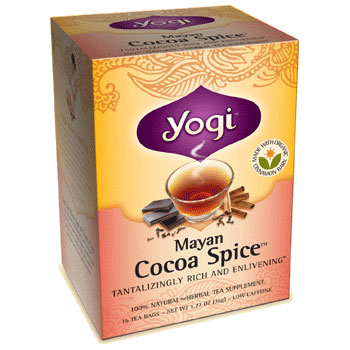
I may seem to be a bit obsessed with the “natural flavors” companies generally put in their products, but they are such a cause for confusion. Recently I bought a box of Yogi Mayan Cocoa Spice tea. Out of habit I checked the label to see if it would be “safe”. Ingredients include:
Organic cinnamon bark, roasted chicory root, organic cardamom seed, stevia leaf, organic ginger root, organic clove bud, organic black pepper, organic cocoa shells, natural chocolate flavor, natural cocoa flavor, cocoa powder, natural vanilla flavor, natural cinnamon oil, natural cardamom oil, natural ginger oil.
Three “natural flavor” ingredients. It gets even more complicated on the website, because on the page for this particular flavor they only list the first nine ingredients and clump the others under “natural flavors” and “essential oils”. When I wandered over to the ingredients page, they defined their natural flavors as being “…derived from natural sources such as spices, fruit, herbs, roots, or many other plants or foods, whose significant function in food is flavoring”. The box states that the company is devoted to using all natural flavors and does not have laboratories where the flavors are concocted. Well, at least that’s promising. But as I’ve come to realize there is potential to use plant extracts which are potential allergens in certain foods (see my various rants about corn!)
I’ve written Yogi asking about the potential for allergens, and as of yet they haven’t written back. Well, I can’t expect everyone to be like KeVita.
http://www.yogiproducts.com/products/details/mayan-cocoa-spice/
http://www.yogiproducts.com/ingredients/N
(image from here)
Thursday, March 24, 2011
*snap!*
You may remember my edit to the condom post about cornstarch being used to prevent the latex from sticking to itself when packaged. Apparently this is common with latex gloves as well. I’m not very comfortable with this because I don’t think that most people would think about corn being in latex. But then again, that’s what this blog is about.
Most of the concern with powdered latex gloves is that latex proteins stick to the powder and are released into the air when the gloves are touched or moved. Therefore, if you have a latex allergy and your doctor uses “safe” gloves on you but uses powdered gloves on other people, there’s a possibility you could still get contaminated through the air. I recognize that this is rather unlikely in real life because of a sort of hyper-awareness that comes with allergies. Anything that could potentially get contaminated is washed if it needs to be just to double check, and it makes sense to simply use non-powdered gloves instead of washing the office from top to bottom.
However, what about the non-latex powdered gloves? Some medical websites do tote “lightly powdered” options (although I think powder-free is the mainstay), so isn’t there great potential for contamination there? I know that the issue is probably under control and that I may be making more out of this than I should be, but I just keep worrying about what if someone with corn intolerance goes to a dentist or something and ends up with corn starch in their mouth?
http://www.aafp.org/afp/980101ap/reddy.html
(kickass Frankenfurter image from here)
Wednesday, March 23, 2011
Where's the corn?
This will probably be only one of many posts about corn products. Corn is everywhere in the American diet. I’ve mentioned this with my last post about how many ingredients are derived from corn, but it gets even more difficult than that. In the case of the beef industry, it seems that cows are what they eat, and what they eat is corn. Traces of corn were found in fast food burgers in this study
This is in part due to the amounts of corn oil used in preparation; however there is also evidence which suggests that cows raised for beef eat so much corn that the nutrients can be detected in the meat itself. Although my boyfriend wouldn’t eat fast food on principle and would also avoid it for the amount of corn oil used to cook the food, just eating regular meat from the grocery store poses the same amount of risk of corn exposure.
Most commercial beef is fed corn in order to get the cows to the desired weight as fast as possible before they are slaughtered. The cows aren’t able to receive the nutrients and corn is not easily digested, so it just collects in the animal. This causes a slew of health problems for the cow, which I won’t go into but can be found here
This ticks me off not really on a basis of ethics, although I don’t agree with corn-feeding beef. For the context of this blog, I am more outraged by the fact that the corn is literally hiding in the meat itself. When people think “beef” they don’t worry about what the cow was eating before it got to the table. I understand why the meat industry doesn’t acknowledge the fact that corn is detectable in their product. If I was them, I wouldn’t either. There’s a lot of backlash about how corn isn’t a sustainable method of feed and how it isn’t anything close to a cow’s natural diet. Putting “contains traces of corn” on the packaging would only bring more attention to the issue.
Luckily, grass-fed beef can be found relatively easily, at least for my boyfriend and I. We’re lucky enough to go to college in an area where there’s a local farmer’s market. All of the places that sell meat are pretty dedicated to the grass-fed practice. However, it is expensive. It’s a little sad when $6.50 per pound is considered the “cheap stuff”. Luckily we only buy it one pound at a time!
(image from here)
Subscribe to:
Posts (Atom)